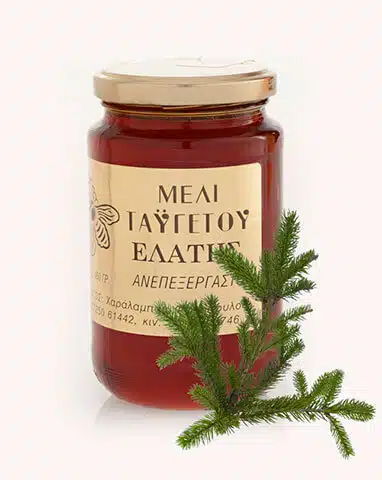
The Cephalonian fir stretches across much of Greece, from the rugged mountains of the Peloponnese and Central Greece to Cephalonia, Euboea, and even the sacred slopes of Mount Olympus and Mount Athos. Vanilla honey, however, is far more selective. It blossoms solely within the fir forests of the Peloponnese, with Mount Mainalo in Arcadia as its historic heartland. For decades, Mainalo was the unrivaled center of production, famed for the exceptional intensity of its honeydew. Beekeepers once gathered on its high ridges, drawn by the promise of this rare and precious harvest.
In recent years, the journey of the hives has widened. Feneos, Panachaiko, Erymanthos, Chelmos, Parnon, and Taygetus have joined the story, where scattered fir stands have given rise to new, localized expressions of vanilla honey, each marked by subtle differences in hue, aroma, and flavor.
In 1996, vanilla honey from Mainalo earned recognition from the European Union as a Protected Designation of Origin (PDO) product. Perhaps this distinction now opens the way for other fir regions to reclaim their place in the landscape of Greek apiculture.
Fir honey is not born of blossoms but of honeydew, secreted by specific host insects known among beekeepers as korios, founda, or kompos. Vanilla honey, in particular, originates from the insect Physokermes hemicryphus, which settles on young fir shoots. The honeydew emerges as dense white droplets or, when more dehydrated, as tiny pale granules clinging to the branches.
Harvest season begins around mid-May — traditionally on May 21, the feast of Saint Constantine — and lasts until mid or late June. When secretion continues beyond this period, the trees yield a deeper, reddish honey, still shimmering with lighter undertones.
Bees gather the honeydew and transform it within the combs through their quiet, almost alchemical labor. Once the frames are removed, the beekeeper enters a race against time: vanilla honey sets quickly, making extraction both demanding and fragile. Combs often crack under centrifugation, and a portion of the honey may remain trapped within the wax.
The extracted honey is then left to mature naturally in containers, slowly clarifying as fine layers of wax, propolis, and pollen rise to the surface. Opening the tap and filling the first glass jars becomes a small ceremony, a moment of reward and reverence for every beekeeper.
Fir vanilla honey does not crystallize, thanks to its high pH, and it preserves its full nutritional richness: low in sugars, abundant in enzymes and proteins, and enriched with vitamins and trace elements such as iron, phosphorus, potassium, and magnesium. Each spoonful is a quiet luxury, a concentrated echo of Greek forests and the hidden life they sustain.
More info and orders contact me or visit the Saturday’s Market